

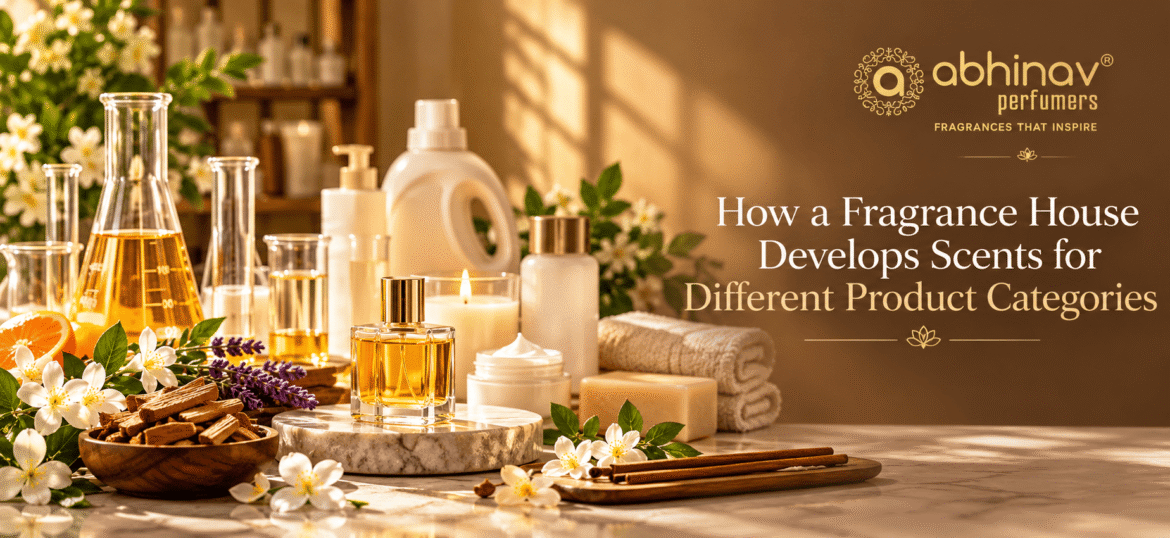
A floral fragrance may smell exceptional in a perfume, barely register in shampoo lather, fade after a laundry rinse, or take on a different character when burned in agarbatti. For a fragrance house, these differences aren’t minor adjustments. They determine how the formula must be built.
A fragrance concentrate is only the starting point. Its performance depends on the product’s base chemistry, how the scent is released, and when consumers experience it. Effective fragrance development must account for all three.
That means fine fragrance, personal care, home care, air care, fabric care, and incense each require distinct formulation decisions.
Why Can’t a Fragrance House Use the Same Formula Across Every Product?
Preserving a scent’s identity doesn’t mean preserving its exact formula. A jasmine-citrus accord may define a brand’s perfume, shampoo and detergent, but the proportions—and sometimes the ingredients – must change to deliver a recognisable fragrance in each product.
Four Factors That Shape Fragrance Development
- Product environment: Alcohol, oils, surfactants, and alkaline cleaners affect fragrance solubility and stability. Incense introduces a combustible substrate and heat.
- Fragrance delivery: Spraying creates an immediate burst. Lathering and wiping release scent during use; washing can remove aromatic compounds, and burning changes how they behave.
- Consumer exposure: Perfume develops on skin over hours. Shampoo has minutes to make an impression, while room fresheners must disperse fragrance into the surrounding air.
- Technical and commercial limits: Ingredient suitability, application-specific IFRA restrictions, recommended dosage and formulation costs influence what a fragrance manufacturer can use.
An experienced fragrance house therefore protects the scent’s recognisable character, not necessarily its original recipe. The objective isn’t simply greater intensity or longevity. It’s a composition that delivers the intended experience within the finished product’s technical and commercial limits.
What Changes in Fragrance Development Across Product Categories?
A fragrance house doesn’t set the same performance target for every product. The real question is where the scent must survive, when it should become noticeable, and what the consumer should experience.
| Application | Main Development Consideration | Critical Evaluation Point |
| Fine fragrance | Carrier, evaporation and skin wear | Evolution from opening to dry-down |
| Personal care | Cleansing base and rinse-off behaviour | Aroma during lathering and rinsing |
| Home care | Cleaner chemistry and base odours | Scent during cleaning and after drying |
| Air care | Delivery system and diffusion | Room distribution and perceived intensity |
| Fabric care | Wash conditions and fibre deposition | Scent retained on dried fabrics |
| Incense | Substrate and burning conditions | Fragrance character during burning |
A floral accord that performs beautifully on skin may disappear during washing. Effective fragrance development therefore preserves the intended scent identity while adapting its composition to the product’s actual use.
Fine Fragrance Development: Designing for Skin, Carrier and Wear
Unlike detergent, where fragrance must survive a wash cycle, fine fragrance is judged by how it develops on skin. Every formulation decision shapes that experience.
How Does the Fragrance Carrier Influence the Composition?
An alcohol-based perfume must maintain clarity and solubility while delivering an expressive opening as ethanol evaporates. Oil-based formats interact differently with aromatic materials, potentially softening the initial impact and changing their release. A fragrance house must adjust the composition to suit the carrier, not simply dilute the same concentrate.
Why Does the Perfumer Evaluate Scent Evolution on Skin?
A fragrance blotter reveals the composition, but skin testing shows how it performs during wear. A fine fragrance manufacturer evaluates three aspects:
- Opening: Immediate impact without excessive sharpness.
- Heart: A recognisable character as lighter materials evaporate.
- Base: Balanced dry-down, projection and lasting presence.
Consider a delicate floral accord. In perfume, it can unfold gradually over hours. In shampoo, that same floral identity must become noticeable within a brief lather-and-rinse experience.
Personal Care Fragrance Development: Balancing Cleansing, Skin Contact and Release
A shampoo has seconds to make an impression, not hours to evolve. For a fragrance house, that changes how a personal care fragrance must perform.
What Changes When Fragrance Enters a Rinse-Off Product?
Fragrance must register during dispensing, become noticeable through lathering, and deliver the intended impression during rinsing. Unlike fine perfume, extended skin projection isn’t the primary objective.
A citrus-floral accord, for example, may need a brighter, more immediate lather-stage character than its perfume counterpart.
How Do Usage Conditions Influence Fragrance Selection?
Surfactant-rich cleansing bases influence fragrance compatibility and release. A fragrance manufacturer must consider:
- Base compatibility: Maintain clarity, colour, viscosity and cleansing performance.
- Skin-contact suitability: Select ingredients and dosages appropriate for rinse-off exposure and applicable safety requirements.
- In-use performance: Ensure the fragrance remains perceptible at realistic usage levels.
The challenge is delivering a memorable scent without compromising the cleansing product itself.
Home Care Fragrance Development: Making Scents Work Within Cleaning Formulations
A cleaner’s fragrance must do two things: remain compatible with the formulation and deliver the right scent when the product is used.
Why Does Cleaning Chemistry Affect the Fragrance Formula?
Acidic bathroom cleaners, alkaline floor cleaners and dishwashing liquids create different formulation conditions. Surfactants and solvents influence fragrance solubility and release, while cleaning ingredients contribute their own background odours.
A fragrance house must ensure the chosen accord remains stable without affecting the cleaner’s appearance, consistency or performance.
Should a Cleaner Smell Stronger During Use or Afterward?
That depends on the application.
- Dishwashing liquids: An immediate, pleasant fragrance during washing.
- Surface cleaners: Noticeable freshness during wiping without an overpowering residue.
- Floor cleaners: A balanced scent during mopping with controlled intensity after drying.
For example, a citrus home care fragrance must be evaluated at working dilution, during mopping and after the floor dries – not merely from the bottle.
Air Care Fragrance Development: Formulating for Diffusion Into a Room
Unlike surface cleaners, air care products must deliver fragrance into the surrounding atmosphere. The challenge is controlling how quickly the scent disperses and how long it remains perceptible.
Why Does the Delivery Format Change the Fragrance Design?
A room spray requires an immediate fragrance burst, while reed diffusers need gradual, consistent release. A fragrance house adjusts the composition according to the carrier, volatility of aromatic materials and delivery mechanism. A formula performing well in one format may release unevenly in another.
How Is Room Freshener Performance Evaluated?
Developers assess three factors:
- Diffusion: How effectively the fragrance spreads beyond the point of release.
- Intensity: Whether the scent is noticeable without becoming overpowering.
- After-effect: Whether the fragrance fades pleasantly or leaves unwanted lingering notes.
For example, a citrus accord suitable for floor cleaning may require reformulation for a room spray, where airborne performance matters more than surface retention.
Fabric Care Fragrance Development: Planning for Washing, Deposition and Drying
A detergent can smell beautiful in the bottle yet leave washed clothes almost scentless. For a fragrance house, the real test begins once the fragrance meets water.
Why Is Laundry Fragrance Evaluated Beyond the Product Bottle?
A fabric care fragrance has four distinct performance stages:
- In the bottle: Remain compatible and appealing before use.
- During washing: Deliver a recognisable scent despite dilution.
- On wet laundry: Remain perceptible after rinsing.
- After drying: Leave a pleasant trace during subsequent fabric handling.
Strong bottle impact doesn’t guarantee fragrance performance after washing.
How Does the Fragrance House Choose Its Release Strategy?
Detergents are designed to remove soils and oils, including some fragrance materials. Developers must balance immediate scent release against deposition onto fibres and fragrance losses during rinsing and drying.
Where suitable and available, encapsulation technologies can protect fragrance materials and enable controlled release through fabric movement. A floral accord that dominates the detergent bottle may therefore need reformulation to remain recognisable on a freshly dried shirt.
Incense Fragrance Development: Designing for Heat, Substrate and Burning Conditions
An agarbatti’s fragrance must work with the material that carries it. Charcoal, wood powders and binders influence how perfume is absorbed, retained, and experienced during burning.
Why Does the Incense Base Matter During Development?
In dipped agarbatti, the fragrance solution must penetrate the dried stick evenly. In masala incense, aromatic ingredients may be incorporated directly into the paste.
A fragrance house considers three formulation priorities:
- Absorption: Compatibility with the substrate and fragrance application method.
- Processing: Performance during dipping, blending and drying, where applicable.
- Storage: Maintaining the intended fragrance character before use.
What Must an Incense Fragrance Deliver During Use?
Unlike perfume on skin, incense fragrance encounters intense heat and odours from the burning substrate. Some aromatic materials evaporate, while others undergo thermal changes.
Developers therefore assess whether the intended scent remains recognisable alongside smoke. For example, a sandalwood accord designed for personal perfume may require rebalancing for agarbatti, where its woody character must remain distinct under burning conditions.
Can a Fragrance House Adapt One Signature Scent Across Multiple Products?
Suppose a brand wants the same fresh floral-citrus identity across its perfume, shampoo, floor cleaner, room freshener, detergent and agarbatti. Can one formula deliver it all? Unlikely. But a recognisable scent character can carry across every application.
How Does a Fragrance House Maintain Scent Consistency?
The fragrance development team makes four critical decisions:
- Preserve: Retain the signature floral-citrus character that makes the fragrance recognisable.
- Rebalance: Emphasise immediate freshness in shampoo, controlled diffusion in room sprays and suitable fragrance retention in laundry products.
- Reformulate: Replace or adjust ingredients where base compatibility, exposure conditions or IFRA restrictions demand changes.
- Reassess: Evaluate each finished product to confirm consumers still recognise the intended scent.
The result isn’t six copies of one perfume concentrate. An experienced fragrance house develops technically distinct compositions that maintain a consistent scent identity while performing appropriately in each application.
What Should Be Tested Before Approving a Category-Specific Fragrance?
A fragrance that smells excellent in a sample vial may perform differently in the finished product. Before approval, a fragrance house must evaluate it under realistic application conditions.
Key Performance Checks by Product Category
| Product | Application-Specific Assessment |
| Perfume | Carrier compatibility, opening, skin projection and dry-down |
| Shampoo | Base compatibility and scent during lathering and rinsing |
| Floor cleaner | Formulation stability and fragrance during and after cleaning |
| Room freshener | Delivery-system compatibility, diffusion and intensity |
| Laundry detergent | Wash-stage release and fragrance retention on dried fabrics |
| Agarbatti | Substrate compatibility and fragrance character during burning |
Testing should use representative finished-product formulations at intended fragrance dosages. Before approval, the fragrance manufacturer must also verify the applicable IFRA category, ingredient restrictions, permitted usage levels and relevant market regulations. IFRA conformity does not replace the finished-product manufacturer’s safety and stability assessments.
The Right Fragrance Is the One Designed for Its Application
A fragrance isn’t successful simply because it smells beautiful in isolation. It must perform in the product people actually use.
For a fragrance house, fine fragrance, personal care, home care, air care, fabric care and incense present distinct challenges shaped by base compatibility, scent release and usage conditions. At Abhinav Perfumers, we approach fragrance development with these application-specific requirements in mind.
Discuss your product application and fragrance requirements with our team.
Frequently Asked Questions About Fragrance Development
1. Can a fragrance house create the same signature scent for different product categories?
Yes. A fragrance house can preserve a recognisable scent identity across perfumes, shampoos, detergents and air fresheners. However, each application may require a different formula to accommodate its base, delivery method and safety requirements.
2. How is fine fragrance development different from personal care fragrance development?
A fine fragrance manufacturer prioritises scent evolution, projection and skin wear. Personal care fragrance development focuses on compatibility with cleansing formulations and delivering a noticeable aroma during short periods of use, such as shampooing or handwashing.
3. Why can’t the same home care fragrance always be used in a room freshener?
A home care fragrance must remain compatible with cleaning ingredients, whereas a room freshener requires effective airborne diffusion. Different carriers and delivery systems can change how a fragrance is released, making reformulation necessary.
4. Why does fabric care fragrance sometimes disappear after washing?
A fabric care fragrance may lose intensity because some aromatic materials are removed during rinsing or evaporate during drying. Fragrance development must balance wash-stage scent release with deposition and retention on fabrics.
5. Can an incense fragrance manufacturer recreate a perfume scent in agarbatti?
A manufacturer can develop an incense fragrance inspired by a perfume’s recognisable character. However, heat, smoke and the incense substrate influence its final aroma, so the composition often requires adjustments rather than direct replication.
6. Does IFRA compliance for one product mean a fragrance is suitable for another?
No. IFRA restrictions and permitted use levels depend on the intended product category and fragrance composition. A fragrance manufacturer must verify conformity for each application, alongside applicable regulations and finished-product safety requirements.
7. Can increasing fragrance concentration solve poor performance in a finished product?
Not necessarily. Higher dosage cannot always resolve poor solubility, unsuitable release behaviour or fragrance instability. A fragrance house may need to rebalance or reformulate the composition rather than simply increase its concentration.
8. What information does a fragrance house need before developing a custom fragrance?
A fragrance house typically needs the product category, base formulation, intended fragrance dosage, target market, desired scent profile, and performance expectations. These details guide ingredient selection and application-specific development.
9. Why does a fragrance smell different in a finished product than in its original sample?
The product’s base ingredients, pH, solvents and surfactants can affect fragrance release and perception. A scent that smells balanced in concentrated form may behave differently when incorporated into shampoo, detergent or cleaning products.
10. How does a fragrance manufacturer determine the right fragrance dosage?
A fragrance manufacturer evaluates scent intensity, base compatibility, stability, cost and applicable safety limits. The ideal dosage is the amount that achieves the intended fragrance performance without compromising the finished product.
11. Can a fragrance house develop a custom scent for a new FMCG product?
Yes. A fragrance house can develop custom compositions around a brand’s scent preferences, product formulation, intended consumer experience, and commercial requirements. The fragrance must then be evaluated in the actual product application.
12. Why do some fragrances change after several months of product storage?
Fragrance materials may react with formulation ingredients, oxidise or gradually change in concentration during storage. Temperature, packaging, and light exposure can also influence stability, making finished-product shelf-life testing important.
13. What is the difference between fragrance stability and fragrance longevity?
Fragrance stability refers to maintaining acceptable characteristics during storage and product use. Fragrance longevity describes how long the scent remains perceptib