

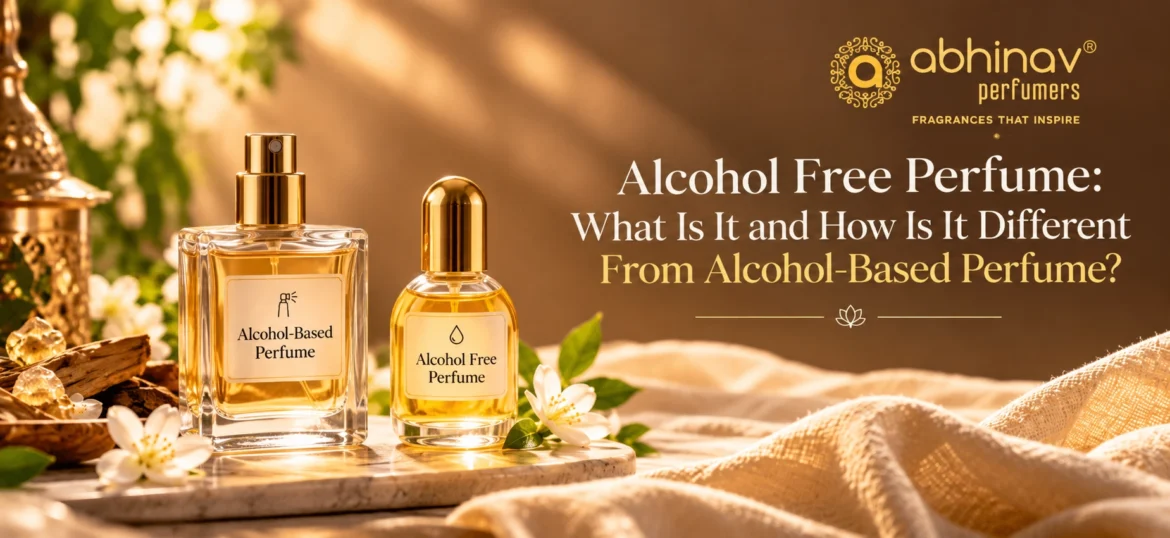
An alcohol free perfume and an alcohol-based perfume can share similar aromatic ingredients yet smell noticeably different on the skin. One may deliver an immediate burst of fragrance, while the other releases its scent more gradually.
The difference lies largely in the carrier. Alcohol doesn’t define a perfume’s scent identity, but it influences how that scent disperses and develops.
Choosing between the two involves more than ingredient preference. Application, projection, longevity, skin feel and formulation suitability all shape the final fragrance experience.
What Does Alcohol Free Perfume Actually Mean?
Alcohol free perfume is a fragrance formulated without ethanol (ethyl alcohol) or denatured ethanol as its carrier. Instead, aromatic ingredients are delivered through an alternative base, such as oil, water-based systems or other suitable carriers.
Does Alcohol Free Mean There Are No Alcohol Ingredients at All?
Not necessarily. Fatty alcohols such as cetyl and stearyl alcohol serve different functions from ethanol. Check for Alcohol, Alcohol Denat. or SD Alcohol on ingredient labels. Labelling requirements vary by market.
Alcohol-Free vs Alcohol-Based Perfume: What Are the Main Differences?
| Feature | Alcohol-Based Perfume | Oil-Based Alcohol-Free Perfume |
| Carrier | Ethanol | Oil or ester |
| Application | Usually sprayed | Rolled or dabbed |
| Opening | Rapid diffusion | Gradual release |
| Projection | Often wider | Usually closer |
| Skin feel | Lightweight, quick-drying | Carrier-dependent, potentially richer |
| Longevity | Formula-dependent | Formula-dependent |
| Fabric contact | Possible marks | Possible oily stains |
| Formulation priorities | Solubility, sprayability, stability | Compatibility, skin feel, stability |
Water-based non alcoholic perfumes may behave differently from oil-based formulations, particularly in application and fragrance diffusion.
Why Do Alcohol-Free and Alcohol-Based Perfumes Smell Different During Use?
Two perfumes can share the same fragrance character yet create different sensory experiences. The carrier influences how quickly aromatic molecules reach the air and become noticeable.
Why Does Alcohol-Based Perfume Have a More Noticeable Opening?
Ethanol evaporates rapidly after application, encouraging the initial diffusion of volatile fragrance materials. This can make an alcohol based perfume feel brighter, sharper and more expansive immediately after spraying.
However, the intensity depends on the fragrance composition, not alcohol alone.
Why Do Oil-Based Perfumes Often Stay Closer to the Skin?
Oil-based non alcoholic perfumes typically use less-volatile carriers that slow fragrance release. Instead of creating an immediate scent cloud, they often deliver a softer, more localised aroma.
Can the Same Fragrance Smell Different in Both Formats?
Consider a citrus-woody accord. In an alcohol-based spray, the citrus character may dominate the opening. An oil-based version might soften that initial freshness, making the woody elements more noticeable.
The difference isn’t simply alcohol versus no alcohol. Carrier compatibility, ingredient balance and evaporation behaviour collectively determine how the finished fragrance smells.
Are All Non Alcoholic Perfumes Oil-Based?
No. Non alcoholic perfumes are available in several formats, each offering a different application experience. An alcohol free perfume doesn’t necessarily contain oil as its primary carrier; its formulation depends on how the fragrance is intended to be delivered.
How Do Different Alcohol-Free Perfume Formats Compare?
| Format | Typical Application | Key Consumer Consideration |
| Perfume oil | Roll-on or dab-on | Controlled application, closer-to-skin scent |
| Water-based perfume | Spray or mist | Lightweight feel; diffusion depends on formulation |
| Solid perfume | Balm or stick | Portable, targeted application |
| Attar | Applied in small amounts | Traditional oil-based fragrance experience |
Water-based perfumes aren’t made by simply mixing fragrance oil with water. They generally require suitable solubilising or emulsifying systems to maintain compatibility and stability.
For fragrance brands, selecting the right perfume without alcohol means considering the carrier, application experience and finished-product performance—not merely removing ethanol from the formula.
Does Alcohol Free Perfume Last Longer Than Alcohol-Based Perfume?
Neither alcohol free perfume nor alcohol-based perfume is automatically longer-lasting. Performance depends on fragrance composition, concentration, application amount and individual skin characteristics.
Why Are Longevity and Projection Not the Same Thing?
These three characteristics determine fragrance performance:
- Longevity: How long the fragrance remains perceptible.
- Projection: How far the scent travels from the wearer.
- Intensity: How strongly the fragrance is perceived at a particular moment.
An oil-based perfume without alcohol may remain noticeable close to the skin, while an alcohol-based spray can deliver stronger initial diffusion without necessarily lasting longer.
Alcohol-Free or Alcohol-Based Perfume: Which Should You Choose?
The better perfume isn’t necessarily the one with or without alcohol. It is the one that delivers the fragrance experience you prefer, from the first application to the way the scent develops throughout the day.
Choose According to How You Want the Fragrance to Behave
Different perfume formats suit different application preferences:
- For an immediate fragrance impression: An alcohol based perfume is worth considering. Rapid ethanol evaporation encourages initial scent diffusion, making the fragrance noticeable soon after spraying.
- For a subtle, closer-to-skin scent: An oil-based alcohol free perfume offers controlled roll-on or dab-on application, often creating a more intimate fragrance experience.
- For a lightweight spray without ethanol: Water-based non alcoholic perfumes can provide a mist-like application, provided the formulation supports effective fragrance dispersion and stability.
- For convenient, targeted application: Solid perfumes offer a portable alternative, allowing fragrance to be applied directly to selected areas without spraying.
- For a traditional perfume oil experience: Attars offer an established oil-based format, typically applied in small quantities to the skin.
Can Personal or Cultural Preferences Influence the Choice?
Absolutely. Some consumers prefer a perfume without alcohol for personal, cultural or religious reasons. Others choose ethanol-based sprays for their familiar application and diffusion characteristics.
However, an alcohol-free label does not automatically establish halal certification or compliance with specific religious requirements. These claims require separate verification.
Ultimately, the right choice depends on how you prefer to apply, wear and experience your fragrance—not on whether one format is universally superior.
Is Alcohol Free Perfume Better for Sensitive Skin?
An alcohol free perfume may feel more comfortable for people who experience dryness or stinging from ethanol-based fragrances. However, removing alcohol eliminates only one potential source of irritation. It does not automatically make the finished perfume suitable for sensitive skin.
Can Perfume Without Alcohol Still Cause Skin Irritation?
Yes. A perfume without alcohol can still trigger irritation or allergic reactions depending on its ingredients and individual skin sensitivity.
Several factors matter:
- Fragrance ingredients: Certain aromatic compounds can cause allergic contact dermatitis, even without ethanol.
- Natural extracts: Essential oils and botanical ingredients are not automatically gentler than synthetic fragrance materials.
- Carrier ingredients: Oils, solubilisers and other formulation components may also affect skin tolerance.
- Individual sensitivity: A fragrance that suits one person may cause discomfort for another.
For fragrance brands, ethanol-free is a formulation claim, not proof of skin safety. Claims such as “suitable for sensitive skin” should be supported by appropriate finished-product safety assessments and relevant testing.
Does Alcohol Free Mean Natural, Fragrance-Free or Halal-Certified?
An alcohol free perfume isn’t automatically natural, fragrance-free or halal-certified. These terms describe different product characteristics, and none should be assumed from the absence of ethanol alone.
Three Claims That Should Not Be Confused
- Alcohol-free vs natural: A perfume without alcohol may contain natural extracts, synthetic aroma compounds or both. Removing ethanol doesn’t establish the origin of its fragrance ingredients.
- Alcohol-free vs fragrance-free: Non alcoholic perfumes still contain aromatic ingredients designed to create a scent. Fragrance-free products, by contrast, are formulated without added ingredients intended to impart fragrance.
- Alcohol-free vs halal-certified: Halal certification may involve ingredient sourcing, processing methods and manufacturing requirements. An ethanol-free formulation does not automatically qualify for certification.
For fragrance brands, these distinctions matter. Claims about natural ingredients, skin safety or religious certification should be supported by appropriate documentation and verification, rather than relying on the alcohol-free label alone.
How Can You Identify an Alcohol-Free Perfume From Its Label?
A perfume labelled “alcohol-free” should not be judged by its marketing claim alone. The ingredient declaration offers useful clues about whether ethanol is present and what carries the fragrance.
Which Ingredients Should You Look For?
When checking a non alcoholic perfume, pay attention to these ingredients:
- Alcohol, Alcohol Denat. or SD Alcohol: Common labelling terms for ethanol or denatured ethanol used in conventional perfume formulations.
- Carrier oils and alternative bases: Ingredients such as jojoba oil or certain esters may indicate an oil-based fragrance format.
- Benzyl alcohol and fatty alcohols: These are chemically different from ethanol and may serve as fragrance components, preservatives or formulation aids.
Importantly, alcohol-free, ethanol-free and oil-based are not interchangeable claims. An oil-based product is not automatically ethanol-free.
For any alcohol free fragrance, review the complete ingredient list and seek manufacturer clarification where necessary, particularly when verifying specific formulation claims.
What Should Perfume Brands Consider Before Developing an Alcohol-Free Range?
Developing an alcohol free fragrance range requires more than replacing ethanol with another carrier. Brands must first define the intended consumer experience, then select a formulation capable of delivering it.
Should Brands Start With the Desired Wearing Experience or the Carrier?
Start with four product decisions:
- Application experience: Will consumers spray, roll, dab or apply a solid perfume?
- Scent behaviour: Should the fragrance create immediate diffusion or remain closer to the skin?
- Consumer preferences: Consider ethanol avoidance, skin feel, portability and cultural requirements.
- Product requirements: Establish target pricing, packaging format and destination markets.
What Should Be Checked Before Approving the Finished Fragrance?
Evaluate the proposed formulation against five criteria:
- Fragrance performance: Does the intended scent character remain recognisable in the selected carrier?
- Physical compatibility: Does the product maintain acceptable clarity, consistency and stability?
- Packaging suitability: Is the formulation compatible with its container and applicator?
- Safety and compliance: Verify applicable IFRA restrictions, finished-product safety and market-specific labelling.
- Commercial feasibility: Assess fragrance cost, production consistency and consumer expectations.
IFRA Category 4 covers hydroalcoholic and non-hydroalcoholic fine fragrances. Removing ethanol does not eliminate safety requirements.
Abhinav Perfumers’ fine fragrance expertise supports application-focused fragrance selection for brands developing different perfume formats.
The Right Perfume Depends on More Than Alcohol Content
An alcohol free perfume and an alcohol-based perfume can express the same scent differently. Carrier choice influences diffusion, skin feel, application and fragrance performance. For brands, the right formulation starts with the intended consumer experience, not simply removing ethanol. At Abhinav Perfumers, our application-focused fine fragrance development approach helps brands select compositions suited to their product requirements. Discuss your preferred scent profile, perfume format and formulation needs with Abhinav Perfumers.
Frequently Asked Questions About Alcohol Free Perfume
1. Can Alcohol Free Perfume Be Made as a Spray?
Yes. Alcohol free perfume can be formulated as a spray using suitable water-based or alternative carrier systems. Not all non alcoholic perfumes are oil-based roll-ons.
2. Does Alcohol Free Perfume Stain Clothes?
Some oil-based alcohol free perfumes may leave marks on fabrics. Staining depends on the carrier, fragrance ingredients and fabric type. Avoid applying perfume directly to delicate clothing.
3. Do Water-Based Non Alcoholic Perfumes Need Preservatives?
Water-based non alcoholic perfumes generally require an appropriate preservation strategy to control microbial contamination. Manufacturers should evaluate preservative effectiveness and microbiological stability in the finished formulation.
4. Can an Alcohol Based Perfume Be Converted Into an Alcohol-Free Version?
Yes. An alcohol based perfume can be reformulated using a non-ethanol carrier. However, maintaining its original scent character, stability and performance may require ingredient adjustments and testing.
5. Are Alcohol-Free Perfumes Subject to IFRA Fragrance Safety Standards?
Yes. Relevant IFRA fragrance ingredient restrictions apply to both hydroalcoholic and non-hydroalcoholic fine fragrances. An alcohol free fragrance must meet applicable limits for its intended use.
6. Is Alcohol Free Perfume the Same as Attar?
Not necessarily. Attar is a traditional perfume format, generally oil-based. Alcohol free perfume is a broader category that also includes water-based sprays, perfume oils and solid fragrances.
7. Can a Non Alcoholic Perfume Still Contain Benzyl Alcohol?
Yes. Benzyl alcohol is chemically different from ethanol and may serve as a fragrance ingredient or preservative. A perfume without alcohol may contain it, depending on the formulation and labelling claim.
8. Does Perfume Without Alcohol Need Different Packaging?
Sometimes. Oil-based and water-based perfumes may require different applicators, container materials and compatibility testing. Packaging selection should reflect the finished fragrance’s physical properties and stability requirements.