

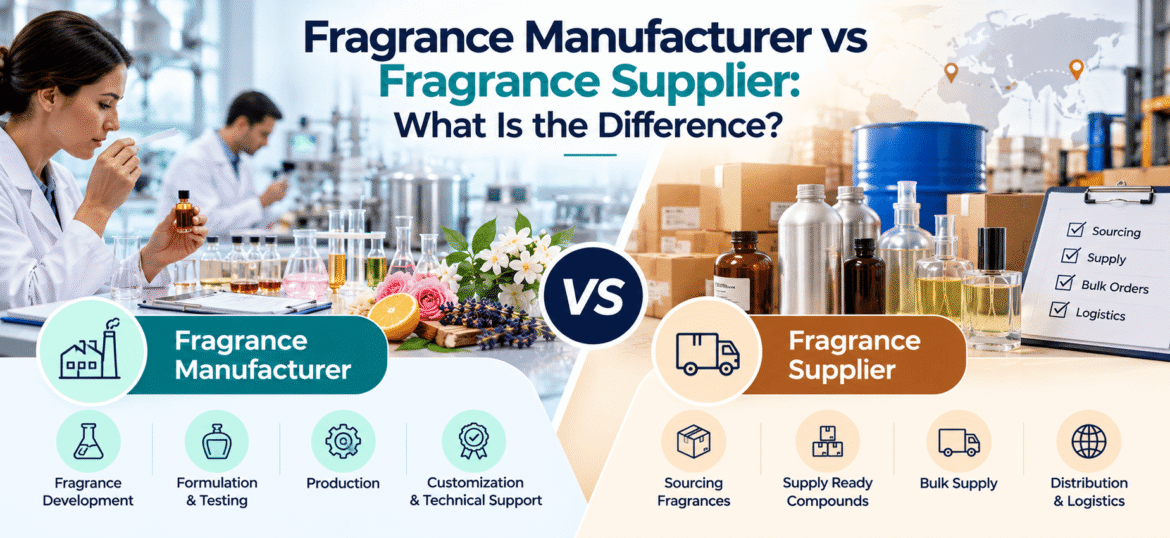
When sourcing fragrance for an FMCG product, the terms fragrance manufacturer and fragrance supplier can sound interchangeable, but they may describe different roles in the development and supply process. Understanding that difference matters when you are comparing fragrance manufacturers in India, discussing a new product, or planning regular bulk purchases.
A manufacturer may be involved in fragrance development, formulation, testing, and production, while a supplier may focus more on sourcing and supplying fragrance materials or finished compounds. However, the exact scope can vary between companies. Knowing what each partner actually handles can help you ask better questions and choose a setup that fits your product, budget, and production requirements.
What does each term actually mean?
The difference is simpler than it may sound. A fragrance manufacturer develops and creates fragrance compounds, working on their composition, testing, and production according to product requirements. A fragrance supplier, on the other hand, mainly focuses on sourcing and supplying fragrances or fragrance compounds to customers. Some companies may handle both roles, so the terms can overlap in practice.
In simple terms: a manufacturer develops and produces the fragrance, while a supplier primarily sources and supplies it.
This distinction matters when choosing a partner. If you need a fragrance developed around a specific product, formula, or target cost, you may need a manufacturer with development capabilities. If you already know what fragrance you need and mainly require regular supply, a supplier may be sufficient.
The actual services offered can vary between fragrance manufacturers in India, so it is worth checking what a company handles in-house before moving ahead.
Who actually creates the fragrance and who just sells it?
The key difference comes down to who creates the fragrance. A fragrance manufacturer typically has perfumers and technical teams who develop fragrance compounds based on product requirements, and you can see how industrial fragrances are made in practice. They can work on the scent profile, make adjustments, test samples, and move an approved formulation into production.
A supplier may work differently. A fragrance supplier can source finished fragrances or compounds from manufacturers and then supply them to customers. In some cases, the supplier may sell these products under its own name without being the company that created the fragrance.
This distinction matters because it can affect how much direct development support you receive. If your product needs a fragrance created or adjusted for a specific formula, working directly with the company developing the compound can provide more direct communication during development. If you already know what fragrance you need and mainly require regular supply, a supplier may meet that need.
So, when comparing a fragrance manufacturer with a supplier, the first question to ask is simple: Who actually develops and makes the fragrance you are buying?
Can a fragrance supplier still help you develop a custom scent?
Yes, but the level of involvement can vary. Some fragrance suppliers work with manufacturers and may pass your brief to a third party for development. In that setup, the supplier may manage communication, samples, and delivery, while the actual fragrance development takes place elsewhere.
This can be convenient if you want one point of contact, especially for standard requirements or bulk fragrance sourcing. However, involving another party can sometimes mean additional communication steps or less direct access to the team responsible for formulation changes.
Working directly with a fragrance manufacturer can be useful when the scent needs several rounds of custom fragrance development, specific product compatibility, or close collaboration with the perfumer. For a brand with a straightforward requirement, a fragrance supplier may still be practical.
The important question is not simply who sells the fragrance, but who actually develops it and how directly you can work with the people responsible for the formulation.
What can a manufacturer do that a supplier usually can’t?
The difference becomes clearer once the fragrance moves beyond the initial sample. A fragrance manufacturer is involved in the technical work behind the scent, so the relationship can continue through testing, production, and later adjustments.
A supplier may coordinate these steps, but if the work is handled by another manufacturer, you may have less direct access to the people developing the fragrance.
A manufacturer with an in-house Quality Control Lab can typically support:
- Application testing: The fragrance can be evaluated in the actual product base to check how it performs before production.
- Batch scale-up: Once a formula is approved, the manufacturer can move it from development quantities toward larger production batches through fragrance blending at different volumes, while working to maintain the approved fragrance profile.
- Technical support: If the fragrance behaves differently in the finished product or needs adjustment, you can discuss the issue with the team involved in its development.
- Ongoing compliance support: Where formulation or regulatory requirements change, the manufacturer may be able to review the fragrance and discuss what adjustments are needed.
This does not make every supplier unsuitable. A supplier can be useful when the requirement is straightforward, and sourcing is the main priority. But if your project involves repeated testing, custom development, or technical changes, working directly with the fragrance developer may provide more direct communication and support.
Does it matter if a fragrance company calls itself a “manufacturer” or “supplier”?
Not necessarily. The title alone does not tell you who actually develops the fragrance. A company may describe itself as a fragrance manufacturer while sourcing some products externally, while a supplier may work closely with manufacturers to fulfil a custom brief.
That is why the label should be a starting point, not the deciding factor; it is also useful to understand what to look for in a fragrance supplier.
Before choosing a vendor, ask:
- Do you formulate fragrances in-house, or do you source them from another manufacturer?
- Where does the formulation and testing take place?
- Can you support changes, scale-up, or technical requirements if the product needs adjustment?
The answers will give you a clearer idea of whether you are speaking directly with a fragrance manufacturer or through a fragrance supplier.
For businesses looking for a custom scent, bulk fragrance supply, or an ongoing production partner, understanding this difference can help avoid surprises around communication, development, and turnaround time.
When Should You Choose a Bulk Fragrance Supplier?
A bulk fragrance supplier can make more sense when you already know the fragrance you need and do not require new formulation work. For smaller orders, a supplier may offer access to existing fragrances without the time involved in developing a custom compound.
This can also be useful when you need an established fragrance for production or product testing and do not require extensive formulation support.
Working with a supplier can keep the process simpler when your requirements are straightforward. You may not need direct access to a perfumer or formulation team if you are purchasing an established fragrance in a standard quantity.
However, if your product needs a distinctive scent, repeated formulation changes, application testing, or technical support as production scales, speaking directly with a fragrance manufacturer may provide more direct involvement in the development process.
So, it is not simply a question of manufacturer versus bulk fragrance supplier. The practical choice depends on whether you need custom development and technical involvement or ready-to-use fragrances with a simpler purchasing process.
What should you check before choosing either one?
Before contacting a fragrance manufacturer or fragrance supplier, a few practical checks can save time later. The right choice is not only about the fragrance itself; it is also about fragrance procurement, sourcing, and whether the vendor can support your order and documentation needs.
- Production capacity: Ask whether they can handle your required quantity consistently, especially if you expect the order to grow.
- Documentation: Confirm what product and regulatory documents they can provide for your intended application and market, along with product base compatibility and stability testing where relevant.
- Sample process: Find out whether samples are available, how custom briefs are handled, and how revisions are managed before placing a larger order.
- Source and location: If you are comparing fragrance manufacturers in India with imported options, consider lead times, shipping, communication, and supply continuity alongside the quoted price.
- Actual role: Ask whether the fragrance is formulated and produced in-house or sourced from another fragrance company.
This simple checklist helps you compare vendors based on what they can actually deliver, rather than relying only on whether they call themselves a manufacturer, supplier, or bulk fragrance supplier.
Conclusion
The difference between a fragrance manufacturer and a fragrance supplier is mainly about the role each one plays in developing, producing, and supplying the fragrance. A manufacturer may handle fragrance development, testing, production, and technical support, while a supplier may focus primarily on sourcing and supplying existing fragrances or compounds.
However, these roles can overlap, so the company’s title alone should not be the deciding factor. Before choosing a partner, ask who develops the fragrance, where testing takes place, how samples and revisions are handled, and what support is available after approval.
For FMCG brands, understanding these differences makes it easier to find a fragrance partner whose capabilities match the actual requirements of the product.
FAQs
1. Is a perfume manufacturer the same as a fragrance manufacturer?
A perfume manufacturer and a fragrance manufacturer can have overlapping capabilities, but they may focus on different products. A fragrance manufacturer can develop fragrance compounds for applications such as personal care, home care, and other FMCG products. A perfume manufacturer may focus more specifically on finished perfumes and related fragrance products. The exact services depend on the company’s capabilities.
2. Do fragrance manufacturers in India also supply internationally?
Some fragrance manufacturers in India also supply customers in international markets, depending on their production capabilities, documentation, logistics, and regulatory requirements. If you are sourcing fragrance from India for an overseas market, it is useful to confirm whether the manufacturer can provide the required documentation and support shipping and compliance requirements for the destination country.
3. Can you buy directly from a manufacturer if you only need a small quantity?
It depends on the manufacturer’s minimum order quantity and production policies. Some manufacturers may provide samples or smaller development quantities before moving to larger production orders, while others may have minimum requirements for commercial supply. It is best to ask about sample quantities, minimum order quantities, and production requirements before starting the project.
4. What should I ask a fragrance manufacturer before placing an order?
Before placing an order, ask the fragrance manufacturer about production capacity, minimum order quantity, sample and revision processes, product compatibility testing, documentation, quality checks, lead times, and batch-to-batch consistency. It is also useful to confirm whether the fragrance is developed and produced in-house or sourced from another company. These questions can help you understand the manufacturer’s capabilities before committing to regular supply.
5. How can I tell if a fragrance company is a manufacturer or supplier?
Ask whether the company develops fragrance compounds in-house, where its formulation and testing take place, and whether it handles production itself or sources the fragrance from another company. You can also ask about its sample development process, production facilities, and technical support. These questions can help you understand the company’s actual role rather than relying only on the label fragrance manufacturer or fragrance supplier.