

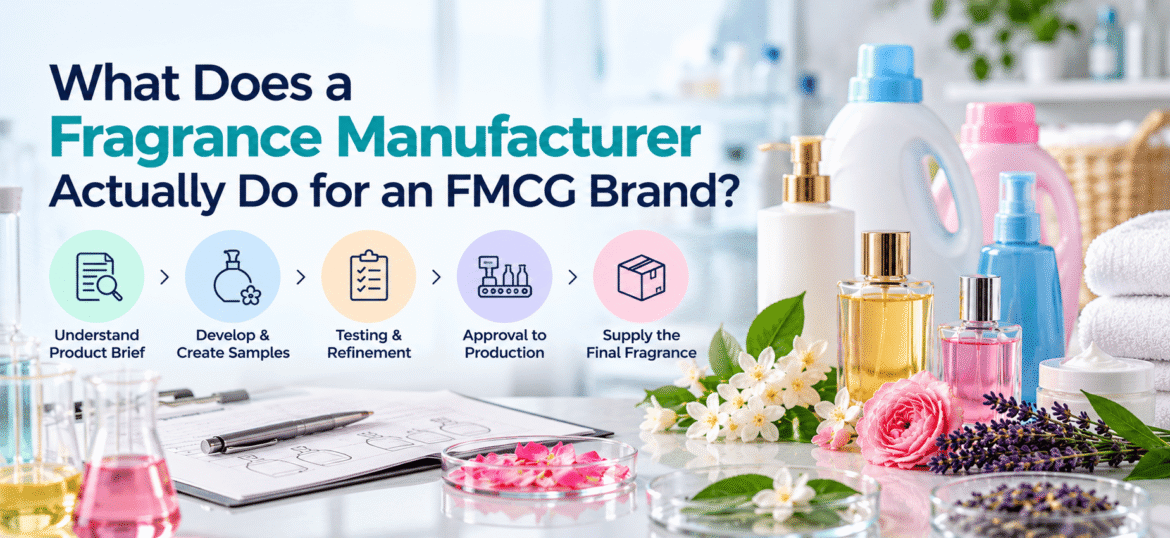
A fragrance manufacturer does more than supply a finished scent. For an FMCG brand, the process can involve understanding the product, developing a suitable fragrance direction, creating samples, refining them through feedback, and supporting testing before production. This matters because the fragrance has to work within the product itself, not just smell appealing on a blotter. Whether you are considering an industrial fragrance manufacturer, industrial perfume manufacturer, a fragrance supplier, or a perfume compound manufacturer, it helps to understand what support you should expect at each stage. Knowing this process also makes it easier to compare fragrance manufacturers in India and ask the right questions before starting development.
What does a fragrance manufacturer actually do, step by step?
Working with a fragrance manufacturer is usually a process rather than a one-time purchase. It starts with understanding what the FMCG brand is making, who it is for, and what kind of fragrance experience the product needs. From there, the manufacturer develops suitable fragrance options, shares samples, and works with the brand through feedback and revisions.
1. Understanding the product brief
The first step is discussing the product itself. The manufacturer may need to understand the product category, target customer, positioning, preferred fragrance direction, and expected price range. A clear brief gives the fragrance development process a practical starting point.
2. Developing and sampling fragrances
Based on the brief, the fragrance manufacturer works on suitable fragrance options and provides samples for evaluation. An FMCG brand can then compare different directions instead of choosing a scent only from a catalogue.
3. Testing and refining the fragrance
The selected samples need to be evaluated in the actual product or under relevant use conditions. Feedback from the brand can lead to changes in the fragrance profile, dosage, or overall direction. This stage may involve several rounds before the final option is approved.
4. Moving from approval to production
Once the fragrance is approved, the manufacturer moves from development to production. The final requirements, specifications and batch expectations need to be clear before manufacturing begins. This is where working with an experienced fragrance supplier can help keep development and production aligned.
5. Supplying the finished fragrance
The final fragrance is then supplied for use in the FMCG product, including applications such as home care fragrances where compatibility with the product base is an important consideration. For brands comparing fragrance manufacturers in India, it is worth asking what support they provide throughout these stages, rather than judging a supplier only by the initial sample.
The exact workflow can vary by product and project, but the key point remains the same: fragrance development is a series of decisions, tests and revisions, not simply buying a ready-made scent.
How does a manufacturer figure out what scent you need?
Before creating samples, a fragrance manufacturer needs to understand what the fragrance has to achieve. The brief usually covers the product type, base or formulation, target price point, and target market. It may also include the desired fragrance direction, application, and any regulatory or usage constraints that need to be considered.
These details matter because the same scent profile may not work in every product or at every price level. A premium personal-care product, for example, may have different fragrance expectations from a mass-market household product. The base can also influence how the fragrance needs to be developed and tested.
A clear brief gives the manufacturer a practical starting point for fragrance development. It also helps avoid receiving samples that are attractive but unsuitable for the final product, budget, or market. The more clearly these requirements are defined at the beginning, the easier it becomes to refine samples, evaluate them properly, and move towards a fragrance that can work in actual production.
How do they actually create the fragrance?
Once the brief is clear, the fragrance manufacturer can begin developing the scent. Perfumers use the agreed product requirements and create an initial fragrance compound that fits the intended application, market, and cost range. This first version is not necessarily the final formula.
The brand then evaluates the sample and shares feedback on aspects such as freshness, strength, character, or overall scent direction. Based on that feedback, the perfumer can adjust the compound and provide another version for review. This process may continue through several rounds until the fragrance meets the agreed requirements.
This back-and-forth is an important part of industrial fragrance development, where formulation requirements, testing, and refinement all contribute to the final fragrance. A manufacturer is not simply sending a ready-made scent and waiting for approval. The final fragrance is shaped through discussion, testing, and refinement between the brand and the perfumer. Once the direction is approved, the fragrance can move toward production with the agreed requirements in place.
Why do they test it inside your actual product, not just on its own?
A fragrance can smell right on its own but behave differently once it is added to the actual product, particularly in Personal Care & Beauty fragrances where the product base can affect how the scent performs. That is why a fragrance manufacturer tests it in the finished product base, whether it is soap, lotion, detergent, or another formulation.
The product base can change how the fragrance smells and develops, which is why understanding how product texture changes fragrance can be important during product development. A scent that seems balanced as a standalone oil may smell different once it is compounded into the formula. This is why testing the fragrance by itself does not always give a complete picture.
Testing it inside the actual product helps the manufacturer see how the fragrance works in the form consumers will actually use. If the scent changes or does not perform as expected, the compound can be adjusted and tested again. This back-and-forth is an important part of fragrance development because the goal is to create a scent that works with the complete product, not just one that smells good on its own.
How do they make sure every batch smells the same?
Once a fragrance has been approved, the work does not simply move from the lab to production. A fragrance manufacturer needs to reproduce the approved scent consistently when production volumes increase. The process involves moving from the initial lab sample to larger batches while keeping the fragrance profile consistent from batch to batch.
This requires controlled production, accurate measurement, and checks during manufacturing. The approved sample acts as a reference, so new batches can be evaluated against it rather than relying only on memory or personal judgement.
Consistency matters because even a small change in a fragrance can affect how the finished FMCG product smells, making fragrance longevity and product performance important considerations during development and production. That is why batch-to-batch consistency is a technical part of fragrance manufacturing, not something that can simply be assumed once a formula has been created.
What happens after your fragrance is delivered?
Delivery is not necessarily the end of the relationship. Once the fragrance is being used in production, new requirements can come up. A formula may need to be reviewed if requirements change, or adjustments may be needed if fragrance raw materials become difficult to source or costs change.
There can also be practical issues after launch, such as a stability concern or a change in how the fragrance performs in the finished product. In these situations, working with the manufacturer can help identify what needs to be adjusted and whether the fragrance requires further development.
For an FMCG brand, this ongoing support matters because products and market conditions can change over time. A fragrance supplier can discuss these changes with the brand and work on practical solutions rather than treating delivery as the final step.
Conclusion
A fragrance manufacturer does much more than supply a scent. From understanding the product brief and developing the fragrance to testing it in the actual formula, maintaining batch consistency, and providing support after delivery, each stage affects the final product. For FMCG brands, understanding this process makes it easier to evaluate a fragrance supplier, ask the right questions, and choose a partner that can support the fragrance from development through production.
FAQs
1. How much does it actually cost to make perfume?
The cost of making a perfume or fragrance can vary depending on the fragrance composition, raw materials, product formulation, development requirements, production quantity, and packaging. For an FMCG brand, the cost is also influenced by the target price point and the type of product being developed. A fragrance manufacturer can help define suitable fragrance options within the required budget and refine the formulation through sampling and testing before production.
2. How much does perfume compound cost?
The cost of a perfume compound can vary depending on the fragrance composition, raw materials, formulation requirements, production quantity, and target price point. A fragrance manufacturer can develop fragrance options according to the product requirements and budget of the FMCG brand.
3. What is needed for perfume manufacturing?
Perfume manufacturing generally requires a suitable fragrance composition, compatible raw materials, the appropriate product formulation, production equipment, quality checks, packaging, and relevant compliance requirements. For an FMCG brand, the exact requirements can vary depending on the product category, formulation, production scale, and intended market. Working with a fragrance manufacturer can help define the requirements from fragrance development through production.
4. How does a fragrance manufacturer develop a custom fragrance?
A fragrance manufacturer typically begins by understanding the product category, target market, fragrance direction, formulation, price point, and other project requirements. Perfumers then develop an initial fragrance compound and provide samples for evaluation. Based on the brand’s feedback, the fragrance can be refined through additional development rounds and tested in the finished product base before approval and production.
5. What should an FMCG brand ask a fragrance manufacturer?
Before starting a fragrance development project, an FMCG brand can ask whether the manufacturer develops fragrances for its specific product category, provides samples and revisions, tests fragrances in the finished product formulation, manages batch-to-batch consistency, provides relevant documentation, and offers support after approval and supply. These questions can help the brand understand the manufacturer’s development process and production capabilities before starting a project.