

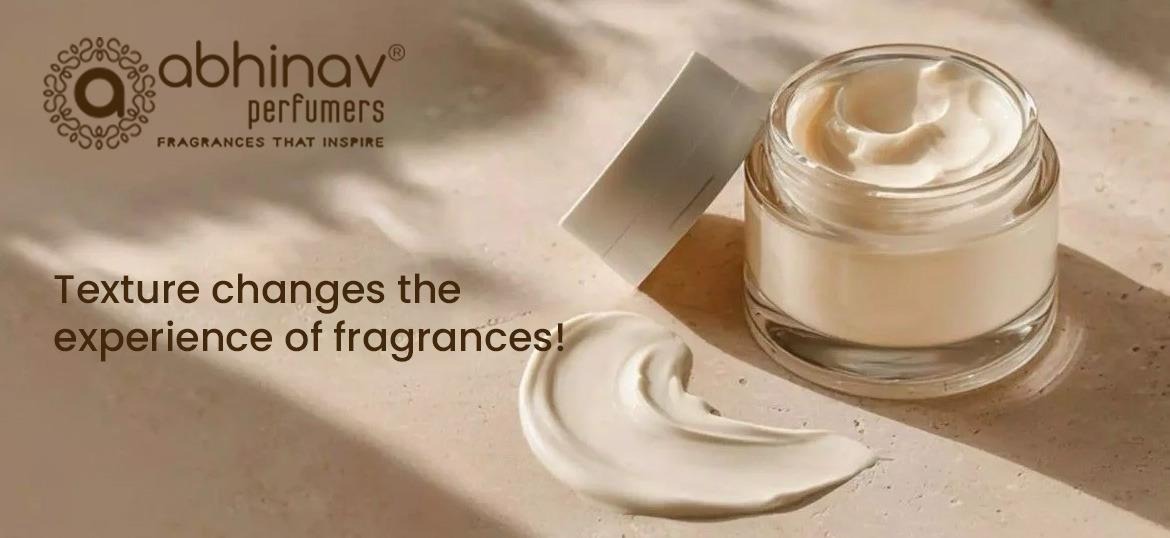
Personal care products are often evaluated through fragrance alone. In product development conversations with personal care fragrance manufacturers and industrial personal care fragrance manufacturers, fragrance is frequently treated as an independent sensory layer that can be designed separately from the base.
However, in real-world consumer experience, fragrance never exists in isolation.
The texture of the product directly controls how Personal Care & Beauty Fragrance behaves, releases, and is perceived on skin.
A fragrance that performs strongly in one formulation can feel completely different in another, even when the dosage and composition remain identical.
This interaction between base texture and fragrance expression is one of the most critical but under-optimized areas in personal care product development.
Why Texture Directly Controls Fragrance Experience
Fragrance molecules are volatile systems. Their release depends on how they interact with the physical structure of the product base.
In personal care formulations, texture determines:
- evaporation speed
- diffusion pattern
- intensity perception
- skin absorption behavior
- longevity of olfactory presence
This means that Personal Care & Beauty Fragrance is not just designed for smell, but for how it behaves inside a specific physical system.
For personal care fragrance manufacturers, this creates a formulation dependency where fragrance design must adapt to base chemistry.
Cream-Based Products and Controlled Fragrance Release
Cream-based formulations are dense systems with higher oil content and structured emulsions.
In such systems:
- fragrance release is slow and gradual
- top notes are softened during application
- base notes dominate longer on skin
- overall perception becomes richer and deeper
Consumers often associate creams with comfort and nourishment partly because fragrance unfolds slowly and steadily.
Industrial personal care fragrance manufacturers often design cream-compatible fragrance systems with enhanced stability and prolonged diffusion curves.
This ensures that fragrance does not evaporate too quickly and remains consistent throughout product usage.
Gel-Based Products and Rapid Fragrance Projection
Gel-based formulations are water-rich, lightweight systems with low viscosity.
In these systems:
- fragrance is released quickly upon application
- top notes become dominant
- intensity is sharp but short-lived
- sensory impact is immediate
This creates a perception of freshness and energy.
For personal care fragrance manufacturers, gels require fragrance systems designed for fast volatility control and clean evaporation profiles.
Without this alignment, fragrance may feel weak or inconsistent after application.
Serum Systems and Minimal Fragrance Expression
Serum formulations are typically active-heavy systems focused on functional performance.
In such bases:
- fragrance must remain subtle
- projection is intentionally reduced
- interaction with active ingredients is tightly controlled
- olfactory presence is background-oriented
This aligns with clinical and functional positioning in modern beauty categories.
Industrial personal care fragrance manufacturers often design low-interference fragrance systems for serums to ensure actives are not masked or destabilized.
Here, fragrance supports perception without dominating it.
Foam-Based Systems and Dynamic Fragrance Release
Foaming systems create temporary structural expansion during application.
This leads to:
- increased surface area exposure
- rapid fragrance diffusion
- short bursts of sensory intensity
- uneven release patterns during usage
Consumers perceive foam-based products as active and dynamic partly due to this fragrance behavior.
Personal care fragrance manufacturers design foam-compatible systems that stabilize release curves during lathering and rinse-off cycles.
Why Fragrance Cannot Be Designed Independently of Texture
One of the most common formulation errors in personal care development is treating fragrance as a standalone additive.
When fragrance is designed without considering texture:
- cream products may feel flat or underwhelming
- gel products may feel overly strong initially but disappear quickly
- serum products may feel chemically unbalanced
- foam products may feel inconsistent in performance
This creates fragmented sensory branding across product lines.
For industrial personal care fragrance manufacturers, this is a critical integration challenge.
The Psychology of Texture-Driven Fragrance Perception
Consumers do not consciously separate fragrance from texture.
Instead, they interpret a combined sensory signal:
- thick textures feel richer and more comforting
- light textures feel fresher and more energetic
- fast absorption feels more modern and clinical
- slow absorption feels more nourishing and premium
Fragrance is interpreted through this physical context.
This means that Personal Care & Beauty Fragrance contributes not only to smell perception but also to product meaning.
Cross-Category Consistency Challenge for Brands
Brands that offer multiple product formats often face a consistency challenge.
A single fragrance family may behave differently across:
- cream
- lotion
- gel
- serum
- foam
Without proper design alignment, this leads to:
- inconsistent brand identity
- fragmented consumer experience
- reduced recognition across categories
Industrial personal care fragrance manufacturers address this by developing fragrance systems that are adaptable across different texture environments.
Role of Personal Care Fragrance Manufacturers in Texture Alignment
Modern personal care fragrance manufacturers are increasingly involved in formulation-sensitive design.
Their responsibilities now include:
- designing texture-responsive fragrance systems
- ensuring stability in different emulsions
- balancing volatility based on product viscosity
- aligning fragrance release with usage patterns
- maintaining brand identity across formats
This expands fragrance design from sensory creation into formulation engineering.
Abhinav Perfumers Perspective
Abhinav Perfumers develops Personal Care & Beauty Fragrance systems that are designed around product texture compatibility rather than standalone olfactory performance.
The approach includes:
- aligning fragrance release curves with product viscosity
- ensuring consistent identity across creams, gels, and serums
- improving stability in active-rich systems
- optimizing sensory balance across product formats
This allows brands to maintain a unified fragrance identity across their entire personal care portfolio.
The Future of Texture-Based Fragrance Engineering
The personal care industry is moving toward more integrated sensory design systems.
Future fragrance development will increasingly focus on:
- formulation-aware fragrance engineering
- controlled release systems based on texture type
- adaptive fragrance behavior across product formats
- precision volatility mapping
As competition increases, brands will rely more heavily on industrial personal care fragrance manufacturers to ensure sensory consistency.
Texture is a primary driver of fragrance perception in personal care products.
Personal Care & Beauty Fragrance cannot be evaluated independently from the physical system in which it operates. Creams, gels, serums, and foams each create distinct sensory environments that alter fragrance behavior significantly.
For personal care fragrance manufacturers and industrial personal care fragrance manufacturers, this makes formulation alignment essential for consistent brand identity.
Brands that understand texture-fragrance interaction create more coherent and predictable consumer experiences across product lines.
In modern personal care development, fragrance is no longer just a layer of perception.
It is a function of texture itself.